Splashback options for Canberra kitchens, bathrooms and laundries
Choosing a splashback for your Canberra kitchen, bathroom or laundry comes down to six materials. This guide compares them on heat, cleaning, repairs, lead time and price.
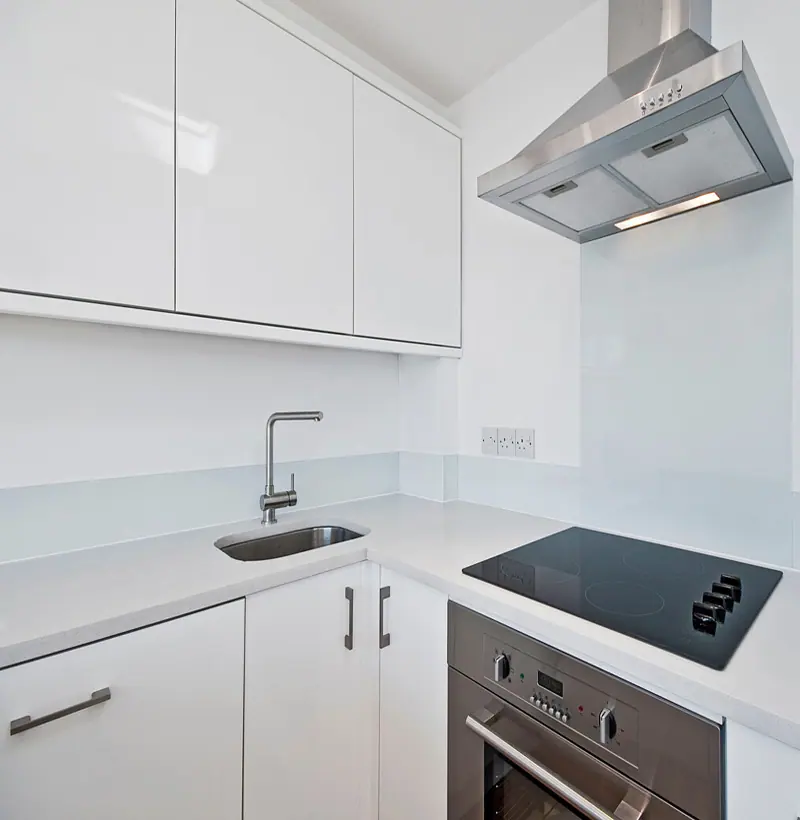
The choice matters less in the showroom than it does once the room has been used for a while. They all protect the wall and they all wipe clean on the day they go in. What separates them is what happens afterwards: how the surface behaves behind a hot cooktop, what cleaning it actually needs, what is involved in fixing one when something goes through it, and how long you wait for it to arrive. Our splashback service page covers what we install and how a job runs. This page is the comparison you make before you call.
The six materials, side by side
| Material | Behind a cooktop | Cleaning | If it is damaged | Lead time | Where it earns its place |
|---|---|---|---|---|---|
| Tiled | Fine. Grout is the part that stains | Wipe the tile, scrub the grout occasionally | The only one where a single piece is cut out and replaced | Off the shelf, fixed on site | Any kitchen, and every laundry |
| Mosaic | Fine, with more grout again | The most grout lines of any option | A sheet can be lifted and re-set | Off the shelf, slower to fix | A short wall meant to be the feature |
| Glass | Toughened, and the clearance is set by your cooktop | One surface, no grout at all | The whole panel is replaced | Cut to measure once the wall is finished | A run between bench and overhead cupboards |
| Custom-printed | As glass | As glass | The whole panel is replaced and reprinted | Printed and cut to order, the longest wait of the six | One wall you want to carry the room |
| Engineered stone | Prohibited from 1 July 2024 | - | - | - | Nowhere. Granite, a porcelain slab or tile takes its place |
| Granite | Resists heat | Wipes clean, sealed occasionally | The whole slab is replaced | Cut to measure, heaviest of the six to fit | A kitchen that gets used hard |
One of the six is here only to be ruled out. Engineered stone has been prohibited from supply and installation in Australia since 1 July 2024, so it cannot be specified on any job, and granite, a porcelain slab or tile does what people used to buy it for.
Read the repair column twice. It is the difference that shows up years after the invoice, and it is the one nobody asks about in a showroom.
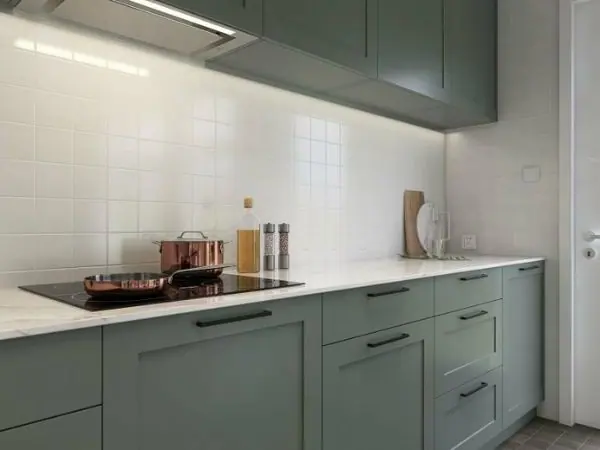
Tile and mosaic: the two you repair a piece at a time
Tiled splashbacks are traditional and come in more colours, sizes and finishes than anything else on the list. The better reason to choose one is duller than the look. A damaged tile is a single tile: it is cut out, the bed is made good, a replacement goes in, and the wall around it is untouched. Keep half a box from the job and that repair is invisible. Grout is the trade-off. It holds stains where a panel does not, it wants a scrub rather than a wipe, and behind a cooktop it is the part that ages.
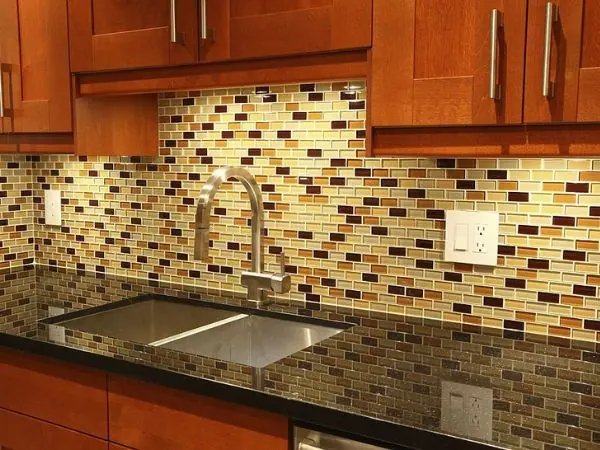
Mosaic is tile with the grout lines multiplied. That is the whole argument for and against it. On a short wall meant to be the feature of the room it does something no flat panel can. Across a long run behind a cooktop, you are buying yourself cleaning.
Both are tiling work, so the per-square-metre numbers sit with the tiles. Our guide to choosing tiles and materials for a wet room has the supply ranges and the labour ladder by tile type.
Glass and custom print: one panel, one measurement
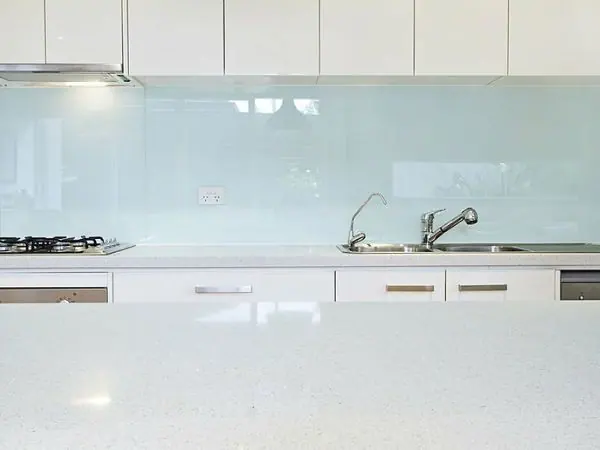
Glass is one sheet with no grout in it at all, which is why it cleans faster than anything else here, and it can be produced in virtually any colour. The catch is the process rather than the product. The panel is cut and toughened off site, so the wall has to be finished, dry and square before it is measured, and it cannot be trimmed when it arrives. Cut-outs for power points are part of that same one-shot measurement.
Custom-printed is the same panel with a pattern, a photograph or artwork printed onto it before toughening. It is the personalised option and the one to be certain about. Every other material on this list can be lived with when you tire of it; a printed image of something you chose in a hurry is the hardest of the six to change your mind about.
Granite: the bench carried up the wall
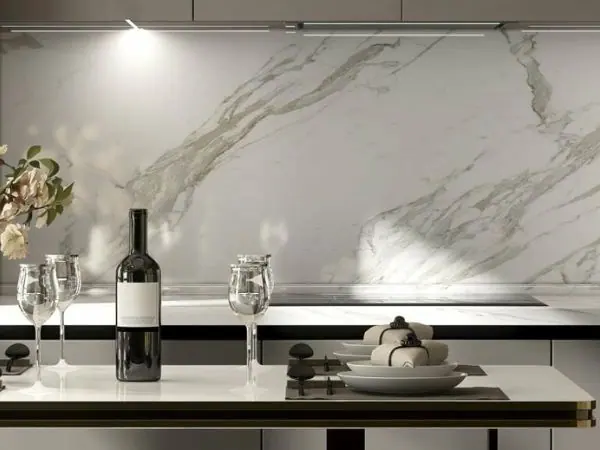
The appeal of a stone splashback is one thing. It is cut from the same slab as the benchtop, so the two match exactly and the join between them stops being visible.
Engineered stone used to be how people bought that, and it no longer is. It has been prohibited from supply and installation in Australia since 1 July 2024, a work-health-and-safety prohibition rather than a preference. Granite, a porcelain slab or tile run up the wall does the same job.
Granite is the one we install. Every piece is different, it is highly durable and heat-resistant, and it suits a kitchen that gets used hard. It is also the dearest of the six and the heaviest to install, which is a fitting question as much as a budget one.
Stainless steel and mirror come up occasionally. Steel belongs behind a cooktop in a kitchen used like a commercial one, and it shows every fingerprint. Mirror makes a small kitchen feel larger and is unforgiving of grease. Both are specialist orders rather than standard choices.
What it costs
A glass splashback runs $300 to $600 per square metre including installation. Treat that as a 2026 planning number rather than a price, and the same applies to the other five materials: the quote comes after we have measured the wall.
As a rough ranking, a tiled splashback is the least expensive of the six and a granite slab the dearest. Area moves the number as much as material does, and so does the number of cut-outs, because each one is a separate operation on a panel that cannot be re-cut. The only figure worth acting on is a quote written against your own measurements.
Before it can be fitted: the wall, the measurement and the wait
The wall behind has to be flat, dry and square. A glass or stone panel is cut to measure off-site and cannot be adjusted once it arrives, so the measurement has to be right the first time. In a bathroom or laundry, any part of the wall inside the wet area is waterproofed to AS3740:2021 before anything is fixed to it. What is included in a bathroom renovation sets out where that line falls in the quote.
Lead time is the half of the schedule people forget. A cut-to-measure glass or stone panel is ordered only once the wall is finished and measured. The wait then has to sit inside your renovation program rather than on the end of it, so the order goes in the day the measurement is taken. Tile is the exception, because it comes off a shelf and is fixed on site.
The fitting itself is the short part; our splashback service page covers the fitting day and who does the measuring. It is also why we do not recommend doing your own. There is no second attempt with a cut panel, and the visible edge of a splashback sits at eye height.
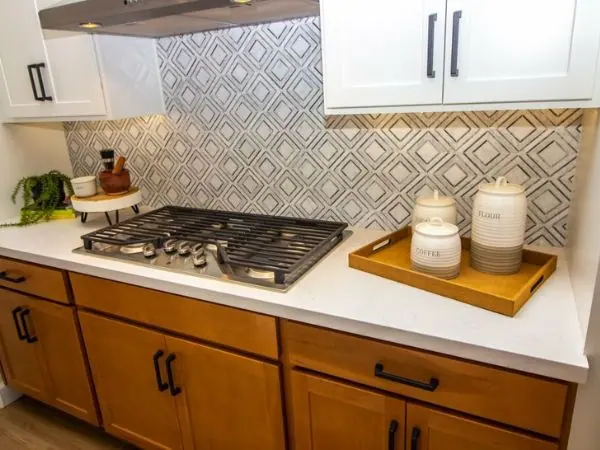
Kitchen, bathroom and laundry: which room changes what
A splashback is not a kitchen-only item, and the room decides more than the catalogue does. In a kitchen it takes heat and grease, so the cooktop clearance and the cleaning matter most. In a bathroom it is the run behind the vanity and basin, where the problem is water at the back of a bench and nothing else. In a laundry it is the wall behind the trough and the bench, and it is the cheapest way to lift a plain room. Our laundry renovation guide covers where it fits in that budget.
One local note. In the ex-government houses and 1960s to 1980s brick homes in Belconnen, Tuggeranong, Woden and the Inner North, the kitchen has only a short strip of wall between the bench and the overhead cupboards. Our splashback service page sets out what fits on a strip that size. What belongs here is what it does to your choice. On a wall that shallow no material reads as a pattern, so the decision comes back to cleaning and repairs rather than looks, and the measurement is worth more attention than the finish. You can see finished rooms in the projects, named by suburb and room.
Keeping it looking new
- Clean regularly with a mild detergent and a soft cloth.
- Wipe spills and splatters away promptly, especially after cooking, before they set.
- Avoid abrasive cleaners and harsh chemicals. They dull the finish and you cannot undo it.
- Check the panel or the tiles now and then for cracks, loose pieces or failed silicone, and get them fixed before water gets behind the surface.
That is the whole maintenance list. A splashback does not need a service contract.
Frequently asked questions
Which splashback material suits a Canberra kitchen best? Tile is the most forgiving and the only one where a single damaged piece can be replaced. A single glass panel suits a short wall between bench and overheads, because there are no grout lines to clean.
Can I put a splashback behind a gas cooktop? Clearances are set by the appliance manufacturer and confirmed by your gas fitter, and they differ by material. We check them before anything is cut or ordered.
Does a splashback need waterproofing behind it in a bathroom or laundry? Where the wall falls inside the wet area, it is waterproofed to AS3740:2021 before anything is fixed to it. Ask your renovator to show you where that boundary sits on your wall.
Can an existing splashback be replaced without redoing the kitchen? Usually yes. The old material comes off, the wall is made good, and the new splashback is fitted to the bench and cupboards you already have.
Can I install a splashback myself? We do not recommend it. Glass and stone panels are cut to measure and cannot be adjusted on site, and the cut-outs for power points have to be exact.
Get a quote for your splashback
Build the room in the instant quote designer and send it to us, or ask for a fast free quote and we will measure the wall properly. Every quote is itemised and written.
Written by Oleg Cha, owner of Apex Bathrooms ACT. Renovating Canberra bathrooms since 2008. Updated September 2026.