How a Bathroom Renovation Works in Canberra
A standard bathroom renovation in Canberra takes two to four weeks. This guide walks homeowners through the four phases, week by week, and what pushes a job longer.
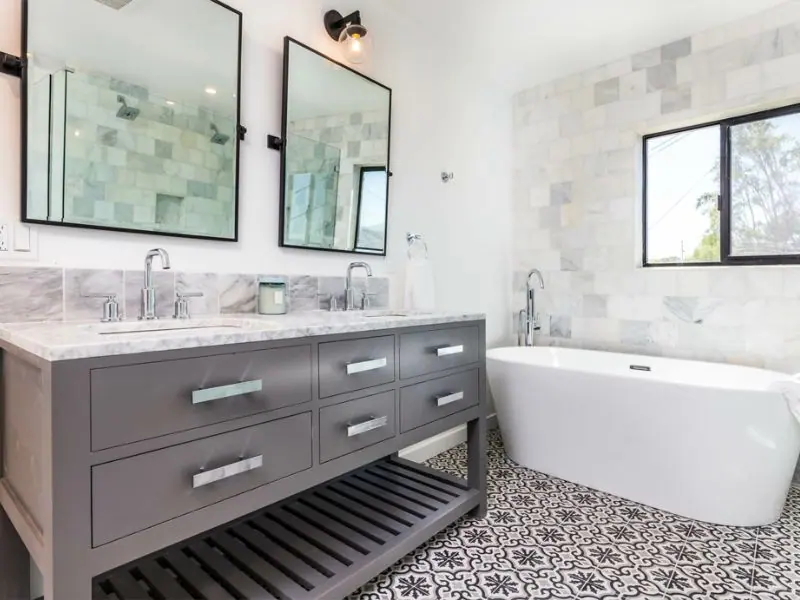
Complex projects - relocated plumbing, a changed layout, custom joinery - run four to six weeks. Those are working timeframes, not sales ones, and the reason they cannot be squeezed is explained further down: waterproofing has to cure.
Before the trades arrive
The quote. We visit, look at the room, listen to what you want and check the condition of the substrate before any price is finalised. You get a free, detailed, itemised quote covering every line item, and a written project timeline with a start date, the key milestones and an estimated completion. Not a rough estimate - a documented schedule you can hold us to. What a quote should contain is in the cost guide, the red flags are in how to choose a bathroom renovator, and the scope it should price is in what a bathroom renovation includes.
Design and selections. Once you are happy with the quote we work through the detail with you: layout, storage, fixture positions, tiles, tapware, lighting and ventilation. Two rules save more money than anything else here. Finalise every selection before demolition, because a decision changed mid-job is the expensive kind. And order everything early - custom joinery has a two to four week lead time from order, which costs no project time at all if the order goes in before the crew starts.
The practical checks. Decide what the room actually needs - storage, plumbing, layout, or only surfaces - and prioritise in that order. Plan ventilation deliberately: an exhaust fan, an opening window, or both. Upgrade ageing pipes and fittings while the walls are open rather than afterwards. Plan the lighting and the mirror together. And use licensed trades, so the work meets the standards it has to meet. Plan where you will wash, too: with a second bathroom you carry on as normal, and with only one you need other arrangements from demolition until the new fixtures are connected. That is about two weeks at best and the full two to four on most jobs, and we set the timing with you at this stage rather than in week one.
Week 1: demolition and substrate preparation
Two to three days. The adjacent areas are protected first - floors, doorways, walls - then the old floor and wall tiles come off carefully so nothing next door is damaged. The vanity, toilet suite, shower screen and tapware come out, then the old waterproofing membrane, then any wall sheeting or substrate that is damaged, non-compliant or unsuitable.
Then the substrate inspection, which is the most important inspection in the whole project. This is where hidden water damage shows up: a rotted subfloor, compromised plaster, old waterproofing that has been failing silently for years. In the ex-government houses and 1960s to 1980s brick homes of Belconnen, Tuggeranong, Woden and the Inner North, we expect to find something rather than hope not to. Moisture testing is done here, as AS3740:2021 requires before any membrane goes on. Whatever the demolition turns up is photographed, priced and talked through with you, and put right before the membrane goes anywhere near it.
The week ends with the substrate repaired, levelled and ready.
Week 2: waterproofing and plumbing rough-in
Three to four days, including mandatory cure time. The membrane goes on in coats, and each coat has to cure before the next can be applied, which is why this week is measured in days rather than hours and why it cannot be shortened. The coat-by-coat sequence - the bond breaker, the coverage heights, the graded shower floor and the cure times AS3740:2021 sets - is in the waterproofing and ventilation guide.
While the membrane cures, the licensed plumber completes the rough-in: shower mixer body, waste fitting, tap bodies and every connection that must be in place before tiling. Those penetrations are waterproofed and sealed as part of the membrane process.
At the end of the week a licensed waterproofer inspects the membrane and issues the waterproofing compliance certificate. No tiler starts before that certificate exists. Our waterproofing service page explains who issues it and what it covers.
Week 3: tiling
Three to five days. Tiles are set out before any are fixed, so the starting point, the set-out lines and the cut positions are confirmed and there are no small cuts at visible edges. Floor and wall tiles go on over days one and two. Grouting follows once the adhesive has cured, along with the cuts at penetrations, edges and niches.
Days four and five are silicone: every movement joint, every change of plane, the internal shower corners and the wall-to-floor junction. Silicone is its own trade step, on its own day, once the grout has gone off.
Large-format tiles such as 600x1200mm or 800x1600mm, and patterns like herringbone or chevron, add one to two days of set-out and cutting. Worth knowing before you choose them, not after.
Week 4: fixtures, fit-out and handover
Two to three days. The plumber returns to connect the mixer, tapware, toilet suite and vanity basin, and tests hot and cold for leaks. The electrician installs or replaces the exhaust fan, the new lighting and the heated towel rail, and wires underfloor heating where there is any. The vanity and mirror go in and are silicone-sealed at the wall. A glazier installs the shower screen - fully frameless screens are measured after tiling, so the measurement is exact.
Then snagging: a detailed inspection of grout lines, silicone joints, fixture operation, screen alignment and tile finish, with anything found fixed before you see it.

Handover: what you are given
A final walkthrough, room by room, confirming you are happy with every element. Then the paperwork, which matters more than it looks:
- the waterproofing compliance certificate;
- the paperwork for our 10-year workmanship warranty, waterproofing included;
- product warranties for all fixtures;
- care instructions for the tiles, the grout and the silicone.
Keep the lot with the house papers. The certificate is what proves the wet area was built to AS3740:2021.
The timeline at a glance
| Week | Phase | Duration | Milestone |
|---|---|---|---|
| 1 | Demolition and substrate preparation | 2-3 days | Substrate inspected, moisture tested, ready for waterproofing |
| 2 | Waterproofing and plumbing rough-in | 3-4 days including cure time | Waterproofing compliance certificate issued |
| 3 | Tiling | 3-5 days | Grout and silicone sealing complete |
| 4 | Fixtures, fit-out and handover | 2-3 days | Certificate and warranties handed over |
| 4-6 | Complex projects: plumbing relocation, custom joinery | - | Final handover with full documentation |
Why the schedule cannot be compressed
The biggest variable in a bathroom renovation is not the tiling or the fixtures. It is waterproofing cure time. Under AS3740:2021 the membrane goes on in multiple coats, each needing a full cure before the next, and the last needing a full cure before tiling - 24 to 48 hours per cycle at normal temperatures, longer when it is cold.
Any renovator who promises to demolish, waterproof and tile a bathroom in three or four days is cutting corners on cure time. It is one of the most common causes of waterproofing failure in bathrooms here, and it is entirely invisible once the tiles are laid. We build cure time into every schedule as non-negotiable.
What extends a timeline
| Cause | Extra time |
|---|---|
| Plumbing relocation, including concrete cutting in slab-on-ground homes | 2-4 days |
| Hidden substrate damage repaired before waterproofing | 1-3 days |
| Complex tile patterns: herringbone, chevron, intricate feature layouts | 1-2 days |
| Cold weather extending membrane cure between April and September | varies |
| Custom joinery ordered late | up to 2-4 weeks from order |
The last one is the only avoidable delay on the list. Order early and the vanity arrives after tiling, exactly when it is needed. Other avoidable delays are covered in the renovation mistakes guide.
Approvals, and the Queanbeyan difference
Most standard bathroom renovations do not need an approval: internal work that changes nothing structural - no load-bearing walls moved, no change to the footprint - is exempt development under the Planning (Exempt Development) Regulation 2023. Structural work, and work on a heritage-listed home, may need approval, and where one is needed it comes from the Territory Planning Authority. All work must comply with the National Construction Code and AS3740:2021, and a waterproofing compliance certificate must be issued and given to you.
Note that the ACT has no local councils, so there is no council to ring. If your home is in Queanbeyan you are across the border in NSW, which means a different regulator and a different approval path for anything structural. We work both sides of it; it is worth knowing which side you are on before you plan a layout change.
Questions about renovation timing in Canberra
How long does a bathroom renovation take in Canberra? Two to four weeks from demolition to handover for a standard bathroom. Four to six weeks where plumbing moves, the layout changes or there is custom joinery.
Why does waterproofing take so long? The membrane goes on in coats, and each coat has to cure fully before the next: 24 hours minimum, then 24 to 48 hours before tiling. Cold weather extends it. Nothing is tiled until a licensed waterproofer has issued the compliance certificate.
What time of year is best for a bathroom renovation in Canberra? September to December. Membranes cure fastest in warm, dry conditions, and autumn and winter add cure days. We work year-round and build extra cure time into schedules between April and September.
How far in advance should I book? Book as early as you can. Quality renovators here are committed weeks ahead, the spring window fills first, and the design and selections stage runs before the crew starts. Your start date is in the written quote.
Get your timeline in writing
Every quote we issue comes with a written schedule, so you know the start date and the milestones before a tile moves. Book ahead: allow six to ten weeks for a standard renovation, and ten to twelve weeks if you want a start between September and November. Use the instant quote designer to build your room and send the design to us, or ask for a fast free quote to book a free site inspection. You can also look at bathrooms we have finished, or read what our bathroom renovation service covers from first visit to handover.
Written by Oleg Cha, owner of Apex Bathrooms ACT. Renovating Canberra bathrooms since 2008. Updated September 2026.