Why I light Canberra bathrooms with hidden light, not a ceiling of downlights
Most Canberra homeowners planning a bathroom open the lighting conversation the same way: how many downlights? I have been renovating bathrooms here since 2008, and these days my answer is fewer than you think. Most of the light should be hidden: behind the mirror, inside the niche, bounced off the walls rather than pointed at your head.
What I mean by hidden light
A downlight is a bright point in the ceiling that throws light straight down. Indirect light is the opposite. The fitting is out of sight, and what you see is the glow it leaves on a wall or the inside of a niche. The room is lit by its surfaces, not by a row of bright dots over your head.
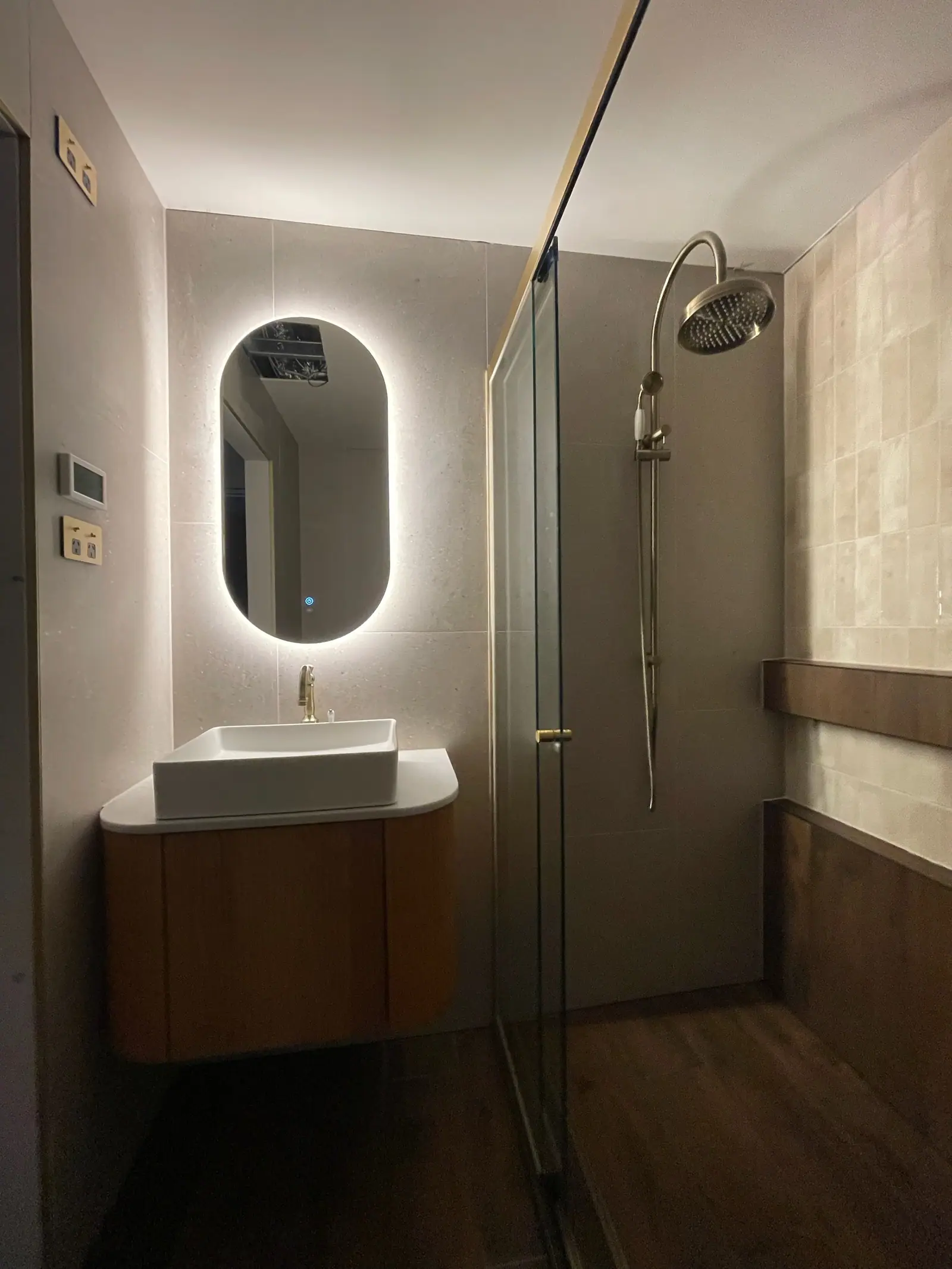
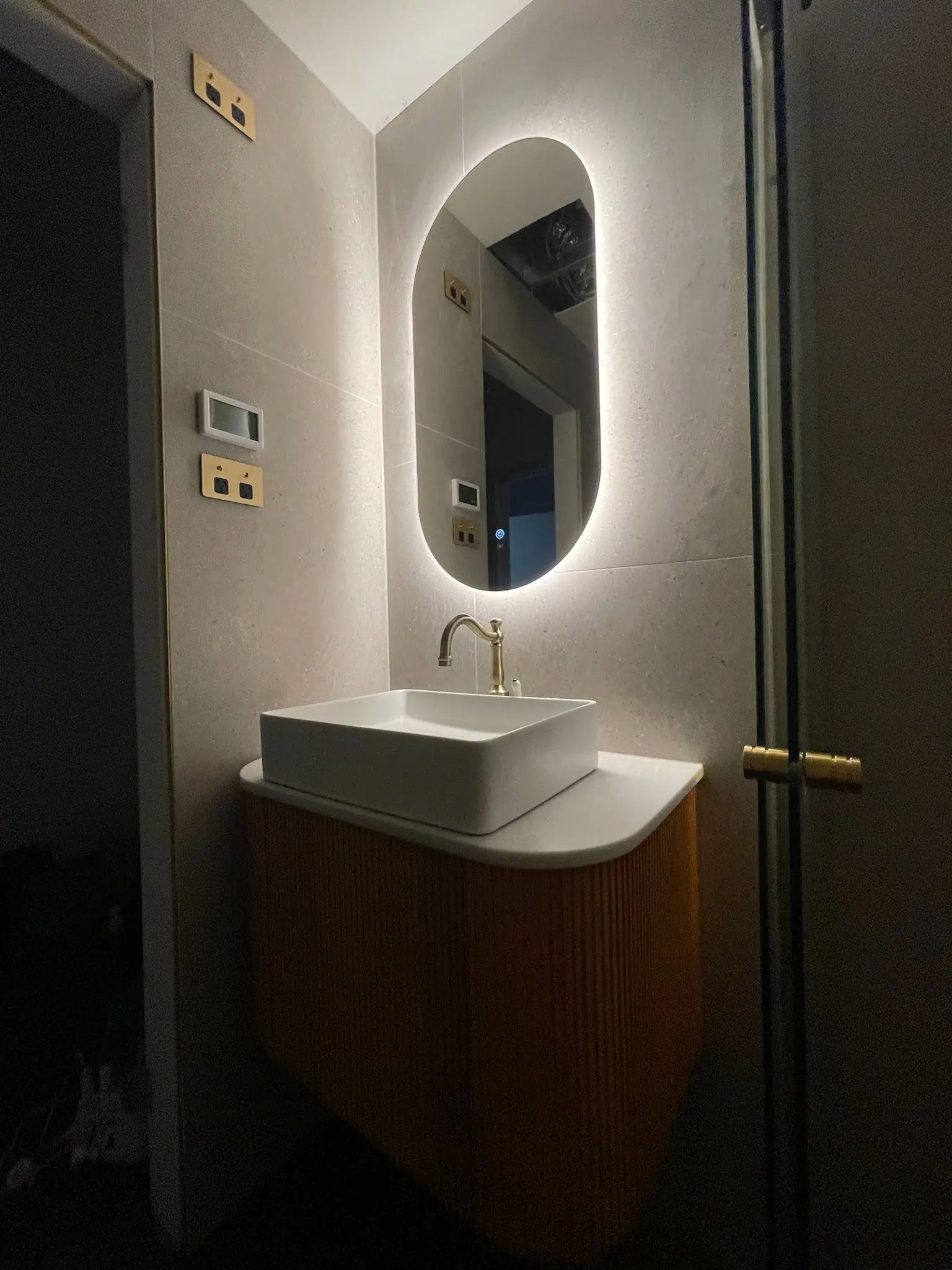
The photos on this page are from the ensuite we are building in Wanniassa, and they were taken with the ceiling lights off. Everything you can see is lit by two hidden sources: the light behind the oval mirror, which washes the wall around it, and the strip that runs the full length of the shower niche. It is the same niche you can see between the two rail showers in our double shower guide; every light in that room apart from the ceiling is hidden. The ceiling lights are there, on a dimmer, for when you need them. At night the family can leave them off and live in the low light.
Why I recommend it
Downlights are hard on the eyes at night. A bathroom is the last room you use before bed and the first one after you wake. Walk into a ceiling full of downlights at eleven at night and you squint. Light bounced off a wall is easy to look at. Nobody squints at a glow.
You wind down faster. This is the part I noticed on jobs long before I read anything about it. In a room lit this way, people slow down. The room feels calmer, and so do you.
It makes the room feel bigger. Light on the walls shows you the edges of the room. One bright source in the middle of the ceiling does the opposite: the centre is bright and the edges fall away into shadow. In the small ensuites in a lot of Canberra homes, a lit wall is the cheapest extra space you can buy.
A downlight over the mirror puts shadows on your face. Light from straight above darkens your eye sockets and the underside of your nose. That is why the mirror in Wanniassa is lit from behind: the glow comes off the wall around it and reaches your face from every side, so there is nothing to cast a shadow. I covered the task-and-ambient layers in choosing a bathroom design; this guide is about getting the ambient layer right.
Fewer holes in the ceiling. Every downlight is a hole in the ceiling, and unless the fitting is rated to have insulation sitting over it, there is a gap in the insulation around each one. In a Canberra winter a bathroom ceiling with eight holes in it is colder than one with two, and the warm air you pay for finds every gap. Two or three well-placed downlights with the right fitting, and hidden light doing the evening work, is a warmer room as well as a calmer one. It helps with winter condensation too, because a warmer ceiling is a drier one.
It is safer at two in the morning. A low light left on, or put on a sensor, lights the room without waking you up. You can see the step, the edge of the shower and the toilet without flicking on the main light, and you get back to sleep more easily. If an older parent lives with you, a room you can see your way across is the difference between a safe trip and a fall.
What the research says
I am a bathroom renovator, not a scientist, so take this as background rather than a promise. But there is some science behind what I have seen on jobs.
- Ordinary indoor light in the hours before bed pushes back the body's night signal. In a 2011 study of 116 people, room light before bed delayed the evening rise of melatonin in almost everyone, and shortened it by about an hour and a half compared with dim light. A dim bathroom at night is kinder to sleep than a bright one.
- Where the light comes from seems to matter as well. Light from straight above lands on the lower half of the retina. A small 2003 study found that half of the eye is the more sensitive one for suppressing melatonin at night; light that reached only the upper half was not significantly different from darkness. A downlight is the worst case, because it comes from directly overhead. Light from a wall, a mirror or a niche reaches the eye from in front. Nine people took part, so I would call it a pointer, not proof.
- Lighting researchers have known since the 1970s that lighting the walls of a room makes it feel more spacious than lighting the middle of the ceiling, and that pools of light feel more pleasant than flat, even light. That matches what I see when the strips go on.
The studies, if you want to read them:
- Room light before bedtime and melatonin, Gooley and colleagues, 2011
- Light on the lower versus the upper retina and melatonin, Glickman and colleagues, 2003
- Flynn's lighting-impression studies, summarised by NIST
How we do it
Plan it at the design stage. A strip in a niche sits inside the build, so the channel and the cable are in before the tiler starts, not chased in afterwards. A backlit mirror does the task light and the glow at once, with no shadows on the face. Put the ceiling lights on a dimmer so the bright setting is there for cleaning and the morning rush. Give the hidden light its own switch, so it can be the only light on at night. Choose warm white over cool white for that layer, and fittings made for a wet area. Electrical work is a licensed trade in the ACT, so the wiring is done by a licensed electrician, and the whole lot is worked out alongside the waterproofing and the tiling as part of the bathroom renovation, not added at the end.
My honest view
Downlights are not wrong. You need bright light to clean a bathroom and to see what you are doing. The mistake is making them the only light. Give the room a hidden layer you can live in at night, and keep the downlights for the daytime jobs. The young family in Wanniassa will use the bright setting for the morning rush and the low light for the hour before bed, the same way they will use their double shower for the years their child wants to be in there with them. That is a bathroom working the way a bathroom should.